 English
 Portuguese
 Bahasa
Melayu
 ไทย
 中文
 Tiếng Việt
 Español
 हिन्दी
 日本語
 العربية

A profitable position can reverse faster than a trader can react, especially around major economic releases or during volatile market sessions. Learning how to place trailing stop orders gives you a practical way to protect an open trade as price moves in your favor without manually adjusting your stop loss every few minutes.
A trailing stop is not a guarantee of profits, and it cannot remove the risks of leveraged forex and CFD trading. It can, however, add structure to trade management. Used with a clear entry plan, sensible position size, and realistic expectations for market volatility, it helps traders stay engaged with opportunity while defining where a winning trade may end.
What Is a Trailing Stop Order?
A trailing stop is a stop-loss instruction that moves in the direction of a favorable market move by a chosen distance. It does not move backward if the market reverses.
For a long position, the stop loss rises as the market price rises. If price then falls by the specified trailing distance, the position is closed at the next available execution price. For a short position, the stop loss falls as price declines and remains in place if the market rallies.
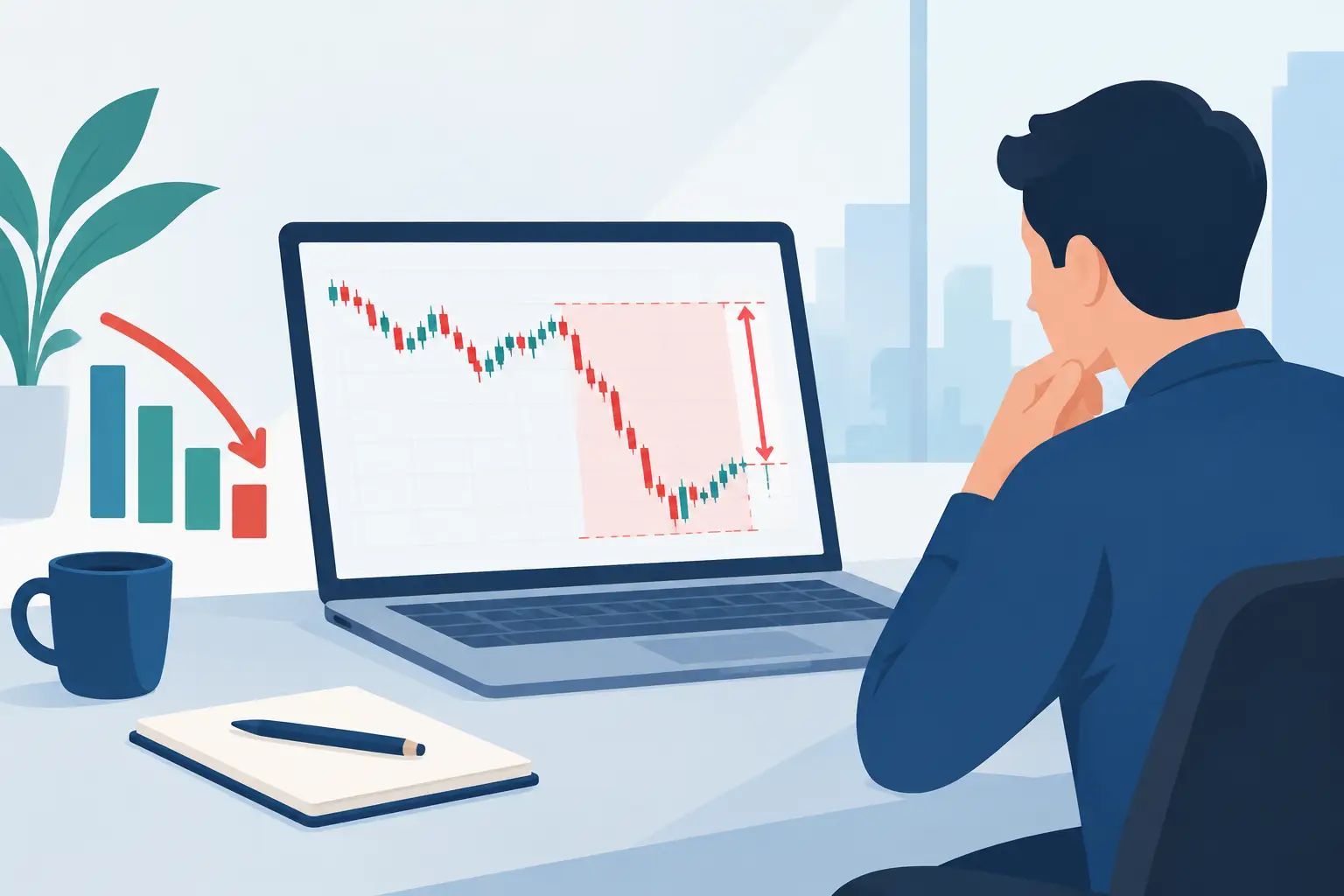
Consider a trader who buys EUR/USD at 1.0800 and applies a 30-pip trailing stop. As EUR/USD rises, the stop follows 30 pips behind the relevant market price. If the pair reaches 1.0850, the stop may have moved up to around 1.0820. The trade now has some protected gain, subject to spread, execution conditions, and any market gaps.
That distinction matters. A trailing stop follows price only after price has moved enough to support it. It is a dynamic risk-management tool, not a prediction tool.
Why Traders Place Trailing Stop Orders
The core appeal is simple: a trailing stop gives a trade room to continue while reducing the need for constant manual intervention. For traders monitoring forex pairs, gold, indices, crypto CFDs, or stock CFDs, that can be useful when several positions are open or when a trend is developing outside their main trading hours.
Trailing stops can support three practical objectives. They can limit downside on an existing position, help lock in a portion of an unrealized profit, and encourage more consistent trade management. Instead of deciding emotionally whether to close after every price pullback, the trader sets a distance that reflects the market and lets the plan work.
There is a trade-off. A stop set too close can be triggered by ordinary price noise, spreads, or a brief pullback before the trend resumes. A stop set too far away may leave more open profit exposed during a reversal. The right distance depends on the instrument, timeframe, volatility, and the strategy behind the trade.
How to Place Trailing Stop Orders on MT4 and MT5
On the MT4 and MT5 desktop platforms, a trailing stop is typically applied from the open positions area. The exact labels may differ slightly by platform version, but the process is straightforward.
First, open a position with an initial stop loss in place if your trading plan calls for one. In the Trade tab or toolbox area, locate the active position and right-click it. Select Trailing Stop, then choose one of the preset distances or enter a custom level where available. The platform will begin adjusting the stop as the market moves favorably by the selected amount.
The distance is usually entered in points, not necessarily pips. This is where many avoidable errors happen. On a five-digit forex quote, 10 points commonly equal one pip. Before confirming the setting, check the instrument’s quote precision and contract specifications so the trailing distance matches your intended risk.
For example, a 200-point setting on a five-digit EUR/USD quote is commonly equivalent to 20 pips. On gold, indices, or crypto CFDs, the price increment and typical daily movement can be very different. A number that makes sense for a major currency pair may be far too tight or too wide for another market.
Keep the Trading Terminal Connected
On standard MT4 and MT5 desktop setups, the trailing stop function generally operates through the trading terminal. Your platform needs to remain running and connected for the stop to keep adjusting. If you close the terminal or lose connection, the stop loss normally stays at its last updated level, but it may not continue to trail the market.
This is different from a regular stop loss already held at the last amended price. That stop can still be eligible for execution under the applicable trading conditions even when the platform is not actively trailing it. Review your platform setup and account conditions before relying on a trailing stop for unattended trade management.
Choosing a Trailing Distance That Fits the Market
The best trailing distance is not a fixed number that works everywhere. It should give the trade enough breathing room for normal volatility while still serving the reason you are using the tool.
A short-term trader may use a tighter trail because the goal is to capture a smaller intraday move and exit quickly when momentum fades. A swing trader holding an index CFD or a major currency pair through several sessions may need a wider distance to avoid being stopped out by routine fluctuations.
Start with the market’s recent behavior. Look at the size of recent candles, average intraday ranges, nearby support and resistance, and scheduled economic events. If a market regularly retraces 25 pips during a trend, a 10-pip trailing stop is likely to close the position early. If your position is intended to be a fast momentum trade, that may be acceptable. If it is intended to stay with a larger move, it probably is not.
It also helps to separate your initial stop from your trailing logic. Your initial stop answers, “Where is the trade idea invalid?” A trailing stop answers, “How much of a favorable move am I prepared to give back?” Those are related questions, but they are not identical.
Common Mistakes to Avoid
The first mistake is activating a trailing stop simply because a trade turns profitable by a small amount. A market can move a few points in your favor and then retrace normally. If the trail is too narrow, you may exit repeatedly without allowing the strategy enough space to perform.
The second is ignoring spread and fast-market conditions. A stop order is designed to trigger when the relevant price reaches its level, but the final fill can differ from the displayed stop price in fast-moving conditions or after a market gap. This is especially relevant for leveraged products, where price changes can have an amplified effect on account equity.
The third is treating a trailing stop as a substitute for position sizing. It is not. A wide trailing distance on an oversized trade can still create more risk than your account plan allows. Define your trade size first, then select a stop structure that fits both the market and the amount you are prepared to risk.
Finally, avoid changing the trailing distance every time price pauses. Constant adjustment often turns a rules-based tool into emotional decision-making. If you need to intervene, do it because market conditions or your original trade thesis have materially changed, not because every candle feels urgent.
Use Trailing Stops as Part of a Trade Plan
Trailing stops work best when the decision is made before the position becomes emotional. Set the conditions for entry, your initial protection level, the point at which trailing begins, and the distance you intend to use. Then review the outcome across a series of trades rather than judging the method from one result.
MT4 and MT5 give traders a familiar environment to manage positions across global markets, while Monaxa provides access to a broad range of instruments for traders who want to build and execute their own approach. Whether you trade major FX pairs, commodities, indices, or crypto CFDs, apply the same discipline: match the trailing distance to the market, not to a hope that a winning trade will never pull back.
A well-placed trailing stop will sometimes close a trade before the market makes another move higher or lower. That is part of the cost of protecting open profit. The goal is not to capture every final point. It is to give your trades a clear process for staying in favorable momentum and stepping aside when the market turns.