 English
 Portuguese
 Bahasa
Melayu
Bahasa
Melayu ไทย
ไทย 中文
中文 Tiếng Việt
 Español
 हिन्दी
 日本語
日本語 العربية
A forex position can look small on your chart while controlling a much larger value in the market. That is where margin enters the picture. If you are asking what is margin requirement in forex trading explained, it is the portion of your account balance your broker sets aside to open and maintain a leveraged position.
Margin is not a fee, and it is not the maximum amount you can lose. It is a good-faith deposit that supports your exposure while the trade remains open. Understanding the difference matters because leverage can increase market access, but it can also make losses move through an account faster than many newer traders expect.
What Is Margin Requirement in Forex Trading?
A margin requirement is the minimum capital needed in your trading account to control a particular position. It is usually expressed as a percentage of the position’s notional value.
For example, a 1% margin requirement means you need to commit $1 for every $100 of market exposure. This is equivalent to 1:100 leverage. A 2% requirement corresponds to 1:50 leverage, while a 0.5% requirement corresponds to 1:200 leverage.
The lower the margin requirement, the less of your own capital is required to open the same trade size. That can provide flexibility for traders who want to access global currency markets with less capital committed per position. It does not reduce risk. Your profit or loss is determined by the full size of the position and the market move, not by the margin you posted.
Margin Requirement vs. Leverage
Margin and leverage are closely connected, but they are not interchangeable.
Leverage describes how much market exposure you can control relative to the funds required. Margin is the amount of funds reserved to support that exposure. The relationship can be calculated with a simple formula:
Margin requirement = 1 ÷ leverage ratio × 100
At 1:100 leverage, the margin requirement is 1%. At 1:500 leverage, it is 0.2%. Higher leverage lowers the upfront margin needed, which can help traders allocate capital across multiple opportunities. It also leaves less room for an unfavorable move if position sizing is aggressive.
This is why experienced traders do not choose a trade size simply because their available leverage allows it. They start with the amount they are prepared to risk if their stop-loss is reached, then determine a position size that fits that risk limit.
How to Calculate Required Margin
The basic calculation is straightforward:
Required margin = position size × market price × margin requirement
Suppose you buy 1 standard lot of EUR/USD. A standard lot represents 100,000 units of the base currency. If EUR/USD is trading at 1.0800, the notional value of the position is approximately $108,000.
With a 1% margin requirement, the required margin would be about $1,080. With a 0.5% requirement, it would be about $540. In both cases, the position controls the same approximate $108,000 exposure. Only the amount reserved from your account changes.
The exact amount displayed on your platform can vary because currency conversion, account currency, contract specifications, and live prices affect the calculation. MT4 and MT5 show margin figures before and after an order is placed, helping traders confirm the capital impact of a position in real time.
Used Margin, Free Margin, and Margin Level
Once a position is open, the margin held to support it is called used margin. The money that remains available for new trades or to absorb floating losses is called free margin.
Your account equity is your balance plus or minus the unrealized profit or loss on open trades. From there:
Free margin = equity – used margin
A related measure, the margin level, shows how much equity you have relative to used margin:
Margin level = equity ÷ used margin × 100
A higher margin level generally means your account has more capacity to withstand adverse price movement. A falling margin level signals that losses are reducing the cushion in your account.
For instance, imagine an account has $2,000 in equity and $500 in used margin. Its margin level is 400%. If open losses reduce equity to $750 while used margin stays at $500, the margin level falls to 150%. The trade is still open, but the room to absorb further losses is much smaller.
What Happens When Margin Runs Low?
Brokerages use margin controls to help manage the risk of leveraged accounts. If your margin level falls to a specified threshold, you may receive a margin call or an on-platform warning that additional funds or lower exposure may be needed.
If losses continue and the margin level reaches the broker’s stop-out threshold, open positions may be closed automatically, usually beginning with the position carrying the largest loss or according to the broker’s execution rules. The purpose is to prevent the account from falling further below the margin needed to maintain open exposure.
Exact margin-call and stop-out levels vary by account type, instrument, and broker policy. Traders should check the applicable trading conditions before opening positions, especially when holding trades through volatile sessions, major economic releases, or weekends.
Why Margin Requirements Change by Instrument
Not every market carries the same margin requirement. Major forex pairs may have different requirements from minor or exotic pairs. Crypto CFDs, indices, commodities, stock CFDs, and ETF CFDs can also have their own leverage limits and margin rules.
That difference reflects market conditions and risk characteristics. An instrument with wider price swings, lower liquidity, concentrated trading hours, or elevated event risk may require more margin. Requirements can also be adjusted during exceptional market conditions or around high-impact news events.
For traders building exposure across several markets, this means available margin should be reviewed at the portfolio level. A position that looks manageable alone can become more demanding when combined with correlated trades. Buying EUR/USD and GBP/USD, for example, may create overlapping exposure to the U.S. dollar rather than true diversification.
Using Margin Without Overextending Your Account
Margin is most useful when it supports a clear trading plan rather than replaces one. Before placing an order, decide where the trade idea is invalidated, calculate the potential loss to that point, and select a volume that keeps that loss within your risk limit.
A few practical habits make a meaningful difference:
- Leave free margin available instead of committing most of your equity to open positions.
- Use stop-loss orders where appropriate, while recognizing that fast markets can produce slippage.
- Watch total exposure across correlated currency pairs and asset classes.
- Reduce position size before scheduled events if volatility could exceed your normal risk tolerance.
- Review the margin requirement for the specific instrument, not just the maximum leverage advertised for the account.
High leverage can be valuable for capital efficiency, but only when paired with disciplined sizing. A trader using lower leverage by choice may have more staying power than one who repeatedly uses the maximum available exposure.
A Simple Margin Scenario
Assume you deposit $1,000 and open a forex position requiring $200 in margin. Your used margin is now $200, leaving roughly $800 in free margin before any unrealized profit or loss.
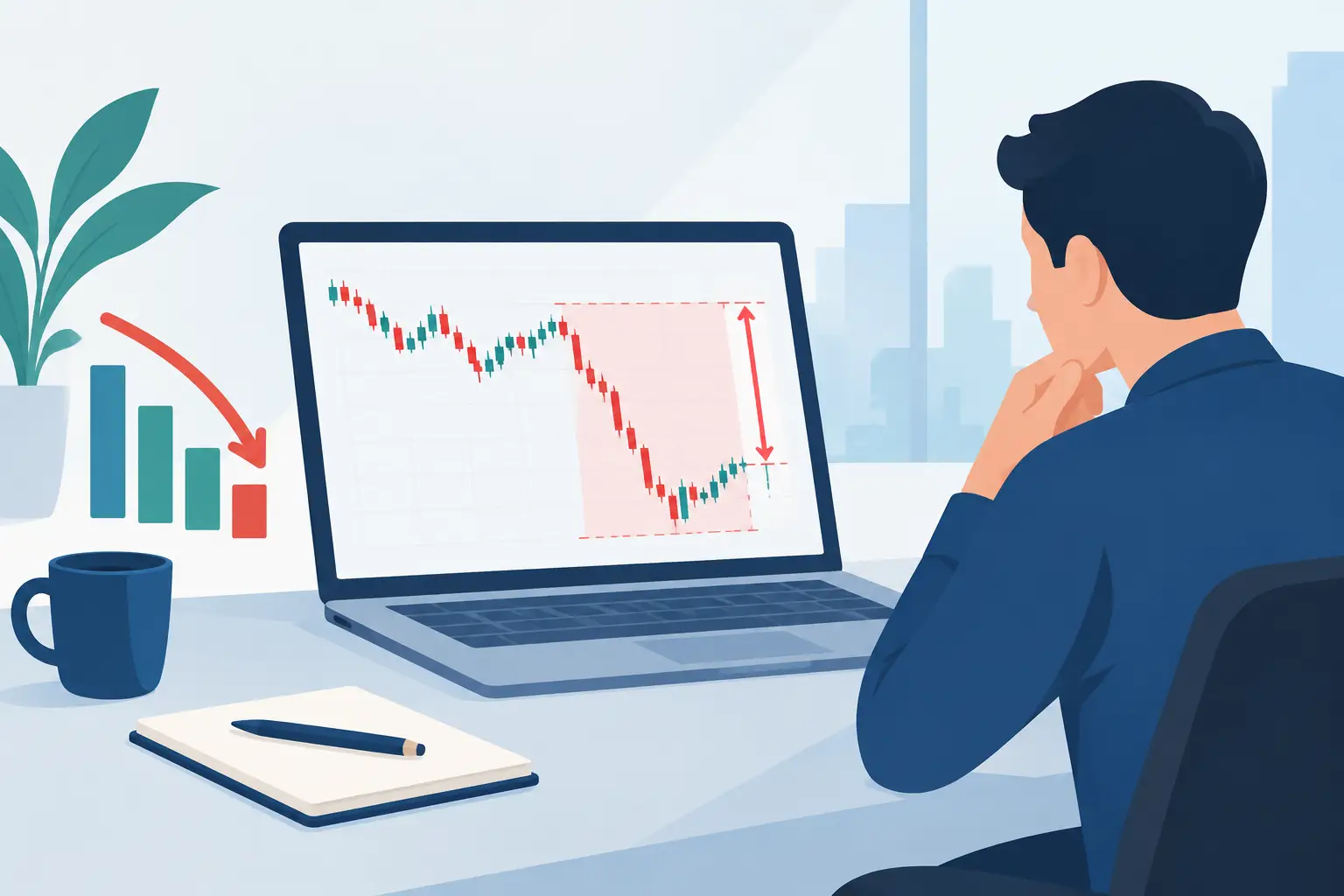
If the market moves against you and the position shows a $300 floating loss, your equity falls to about $700. Used margin remains near $200, so free margin falls to roughly $500. You can still hold the trade, but the loss has reduced your buffer.
If losses deepen, the margin level keeps dropping. The key point is that the original $200 margin did not cap the possible loss. It only enabled a larger market position. Your true risk depends on trade size, price movement, volatility, and whether you manage the position with defined risk controls.
Margin gives traders access to larger market exposure without fully funding the notional value of every trade. Used carefully, it can support flexible participation across forex and CFD markets on platforms such as MT4 and MT5. Treat it as a capital-management tool, not a reason to trade larger than your plan can support.